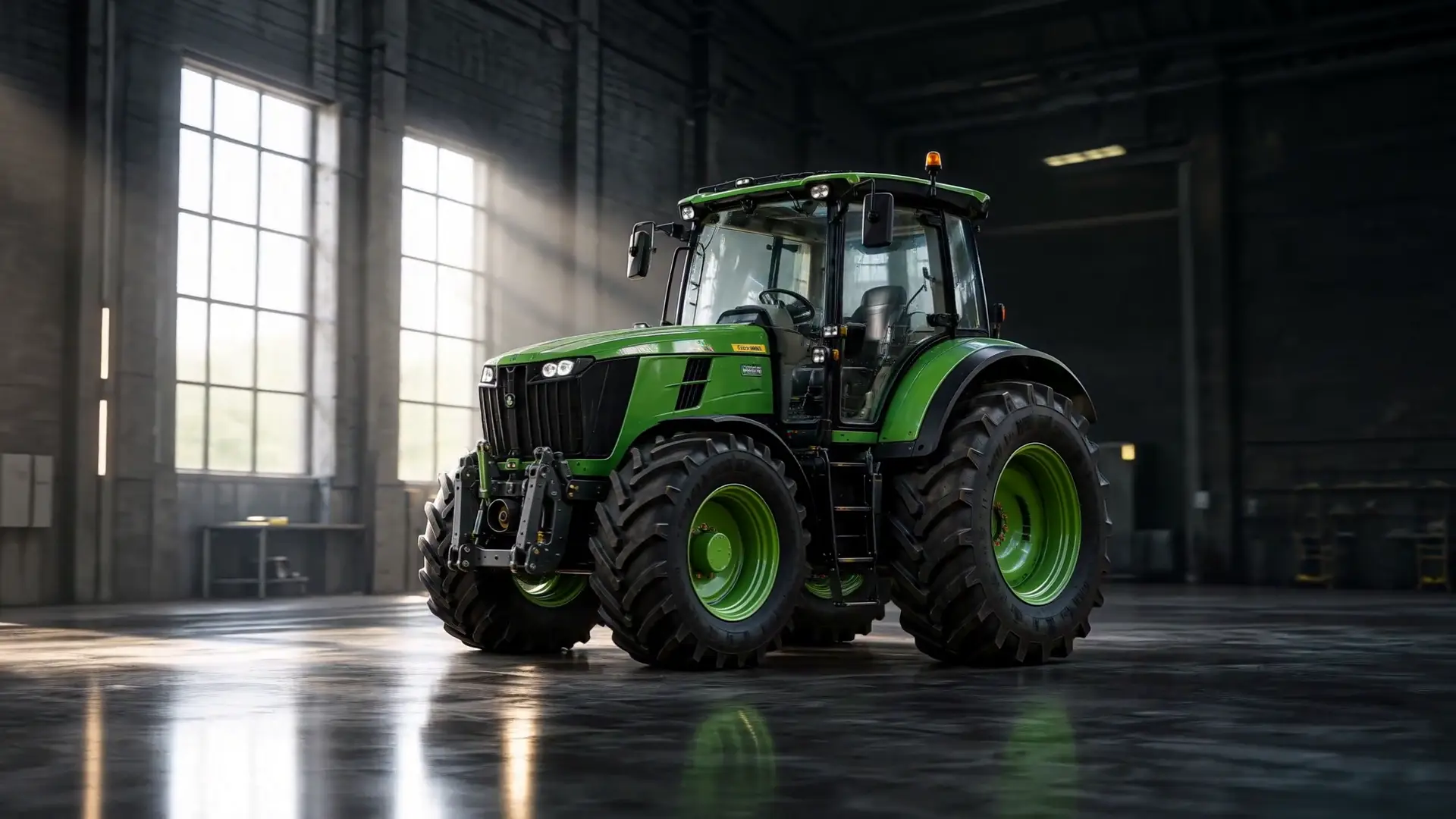
Precision planter (maize drill)
A precision planter, also called a precision drill or maize drill, places single seeds at an exact spacing along each row rather than a stream of seed. It is used for maize, sugar beet, sunflowers, soya and other crops where every plant needs its own space.
How it works
Each row has its own row unit on a parallelogram linkage, so it can ride up and down with the ground independently of the frame. Inside the seed meter a spinning disc has a ring of holes sized to the seed, about 5.5 mm for maize on one common drill. Air holds one seed in each hole: either suction behind the disc (vacuum) or pressure in front of it. Small scrapers called singulators knock off any doubles so each hole carries just one seed.
At the release point the air is cut off and the seed drops or is blown down a short tube into a slot opened by discs. Depth wheels set the depth, down-pressure keeps the unit in the ground (up to about 300 kg per row on some planters) and closing wheels firm the soil over the seed. A separate coulter often places fertiliser beside the row at the same time. Cab monitors show how many seeds are being singled correctly, often 98% or better.
Main types
- Vacuum planter: A fan sucks air through the disc holes to hold seed. The most common design for maize.
- Positive pressure planter: Air pressure presses seed on to the disc and then helps fire it down the tube. Vaderstad's Tempo uses this to plant at about 12 km/h.
- Mechanical precision drill: Cells or belts pick single seeds with no air system, a design long used for sugar beet and vegetables.
- Mounted and trailed: Mounted planters of six or eight rows suit smaller farms; wide trailed or folding machines carry big seed and fertiliser hoppers.
Hooking it up to a tractor
Planters are mounted on the three-point linkage or trailed on the drawbar. The vacuum or pressure fan is driven by the PTO or by tractor hydraulics, and further hydraulic services fold the frame and work the markers. Row spacing is usually between 45 and 75 cm, so the tractor's wheels may need setting to run between rows.
A short history
In the American corn belt, check-row planters dropped seed in hills on a square grid so the crop could be cultivated both ways. By about 1860 knots on a rope stretched across the field tripped the seed droppers, and knotted wire was the standard by the 1870s. Herbicides, wider multi-row planters and combines that suited continuous rows ended check-row planting in the twentieth century. Electronic seed monitors and computer control followed from the late 1970s.
Buying and care tips
- Right disc for the seed: Use the disc and singulator setting matched to the crop and seed size, and keep spare discs for each crop.
- Check for air leaks: Worn seals, cracked hoses and dirty discs lower vacuum or pressure and cause misses and doubles.
- Clean seed tubes: Dirty or damaged tubes make seed bounce and ruin spacing. Hillsides also affect spacing, so drive slower on slopes.
- Test before the field: Run the meter and check the monitor readings, then dig up a few metres of row to check depth and spacing.
Questions people ask
What does singulation mean?
Singulation is the planter's ability to put exactly one seed in each place. Monitors report it as a percentage, with misses and doubles counted separately.
Vacuum or pressure planter: which is better?
Both work well. Vacuum is the most common design, while pressure systems can push seed down the tube faster to keep spacing at higher speeds.
Can I sow maize with a normal seed drill?
It can be done, but plants end up unevenly spaced and yields usually suffer, which is why maize is normally sown with a precision planter.
Related equipment
Sources
- Maestro DV precision planter (Horsch)
- Farmer's view: Vaderstad Tempo maize drill (Farmers Weekly)
- Corn Belt check-row planters (Farm Collector)
- Global overview of research progress and development of precision maize planters (IJABE)
Last checked 2026-11-01