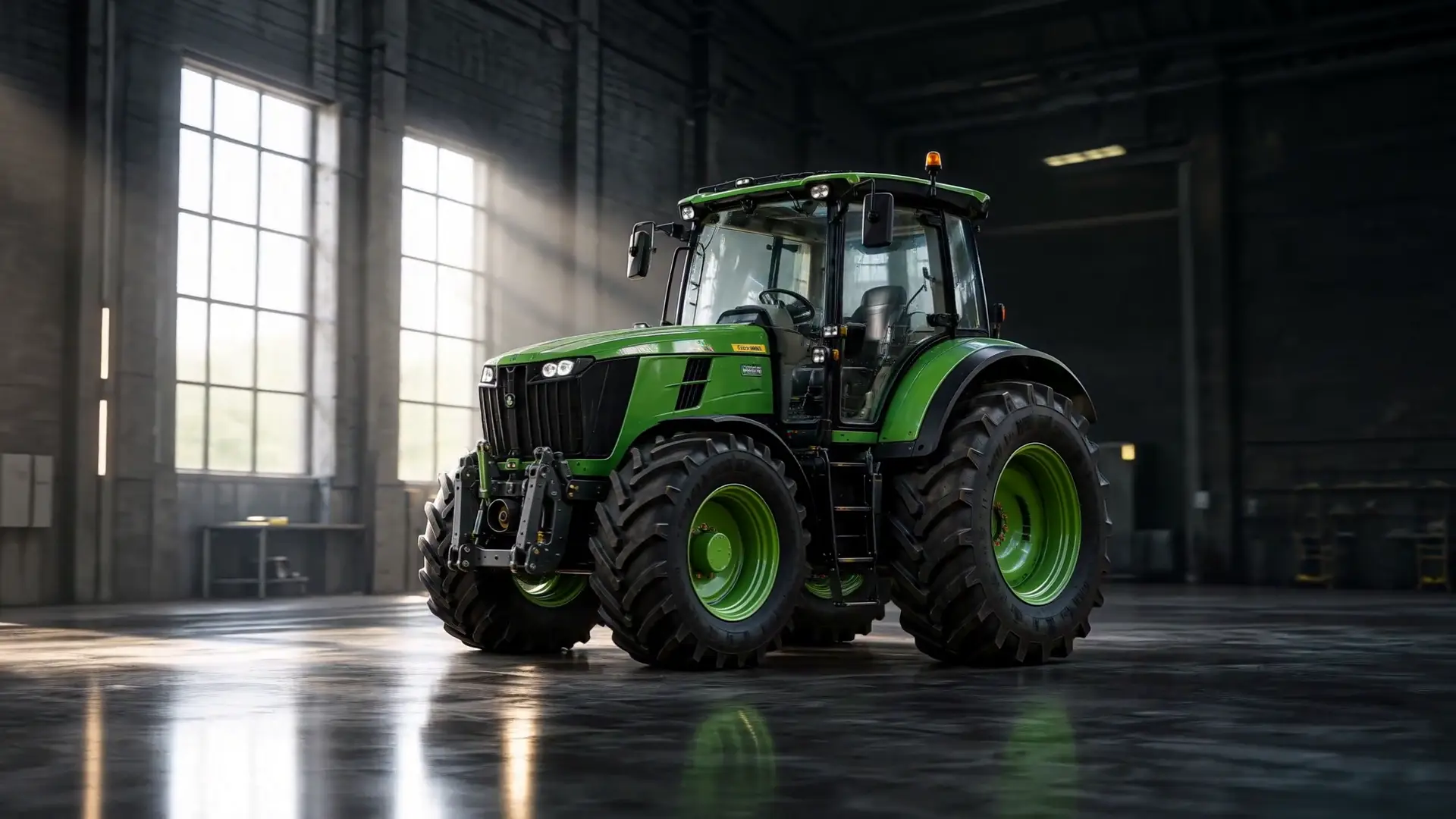
Three-point linkage
The three-point linkage is the set of two lower arms and one top link at the back of a tractor that carries and lifts implements. Developed by Harry Ferguson, it lets the tractor's hydraulics raise, lower and control the depth of ploughs and other tools.
Tractor power needed: Category 0 up to about 20 hp through to category 4 above about 180 hp
How it works
Two lower links, raised and lowered by the tractor's hydraulic lift arms through adjustable lift rods, carry most of the weight. The top link, an adjustable rod above them, completes a triangle that holds the implement steady and sets its pitch. The implement attaches with pins through ball ends on each link, and stabilisers or check chains stop it swinging from side to side.
Draft control is the clever part. The pull, or draft, of a soil-engaging tool such as a plough is sensed through the linkage; on Ferguson's original design the top link pushed on a spring that worked a hydraulic valve. When the plough hits heavier soil and the draft rises, the hydraulics lift it slightly; when the draft falls, they lower it again. That keeps the load on the tractor steady and transfers weight onto the rear wheels for grip. Position control simply holds the implement at a set height, which suits mowers and sprayers. Modern tractors often sense draft electronically at the lower link pins.
Linkage categories
- Category 0: Garden and small compact tractors up to about 20 hp. Top and lower pins 16 mm, lower hitch spacing about 510 mm.
- Category 1: Roughly 20 to 45 hp. Top link pin 19 mm, lower pins 22 mm, spacing about 710 mm.
- Category 2: Roughly 40 to 100 hp. Top link pin 25 mm, lower pins 29 mm, spacing about 860 mm.
- Category 3: Roughly 80 to 225 hp. Top link pin 32 mm, lower pins 37 mm, spacing about 1,020 mm.
- Category 4: Over about 180 hp. Top link pin 44 mm, lower pins 51 mm, spacing about 1,220 mm.
- Narrow (N) versions: Use the pin size of one category with the spacing of the one below, so a big tractor can carry a smaller implement. Common on quick hitches.
Using it with implements
Category is about pin size and spacing, not only power, so ranges overlap. Bushes and reducing sleeves let you fit a smaller-category implement to a larger tractor. A quick hitch, a frame on the lower links and top link, lets the driver pick up implements without leaving the seat. Many larger tractors also have a front linkage for front mowers, presses and weights.
A short history
Harry Ferguson, an engineer from County Down, worked on implement hitches from about 1917 with Willie Sands, first on a plough for converted Ford cars and then for the Fordson. A two-point hitch led to a three-point design with hydraulic control, patented in the 1920s. His Black Tractor of 1933 combined the linkage and draft control, followed by the Ferguson-Brown Type A built with David Brown from 1936. A demonstration to Henry Ford in October 1938 led to a handshake agreement and the Ford-Ferguson 9N of 1939. The TE20 followed from Coventry in 1946. After the patents expired in the 1960s, the system became a standard across the industry, now covered by ISO 730.
Hitching and care tips
- Level the implement: Use the top link to set the implement level front to back, and the lift rods to level it side to side.
- Set the stabilisers: Lock the side movement for transport and for tools such as power harrows; allow some float for ploughs.
- Check the weights: Heavy rear implements lift the front wheels. Add front ballast so steering stays safe.
- Never stand between tractor and implement: Most hitching injuries happen when a helper is caught as the linkage moves.
- Inspect ball ends and pins: Worn balls and pins give sloppy, unsafe hitching. Always fit linch pins.
Questions people ask
What are the three-point linkage categories?
Categories 0 to 4 set the pin diameters and spacing of the links, from small garden tractors up to the largest farm tractors. Narrow (N) versions mix one category's pins with the next smaller spacing.
What is draft control on a tractor?
A hydraulic system that senses how hard an implement is pulling and raises or lowers it slightly to keep the load steady. It was the key part of Harry Ferguson's system.
Who invented the three-point linkage?
Harry Ferguson developed and patented the hydraulic three-point linkage with draft control in the 1920s, and it became widely known through the Ford-Ferguson 9N and Ferguson TE20.
Can I fit a category 1 implement to a category 2 tractor?
Usually yes, using reducing bushes on the pins, as long as the tractor can lift it safely and the spacing suits.
Related equipment
Sources
- Three-point hitch, Wikipedia
- The three-point linkage, Friends of Ferguson Heritage museum
- Harry Ferguson, Farm Collector
Last checked 2026-11-01