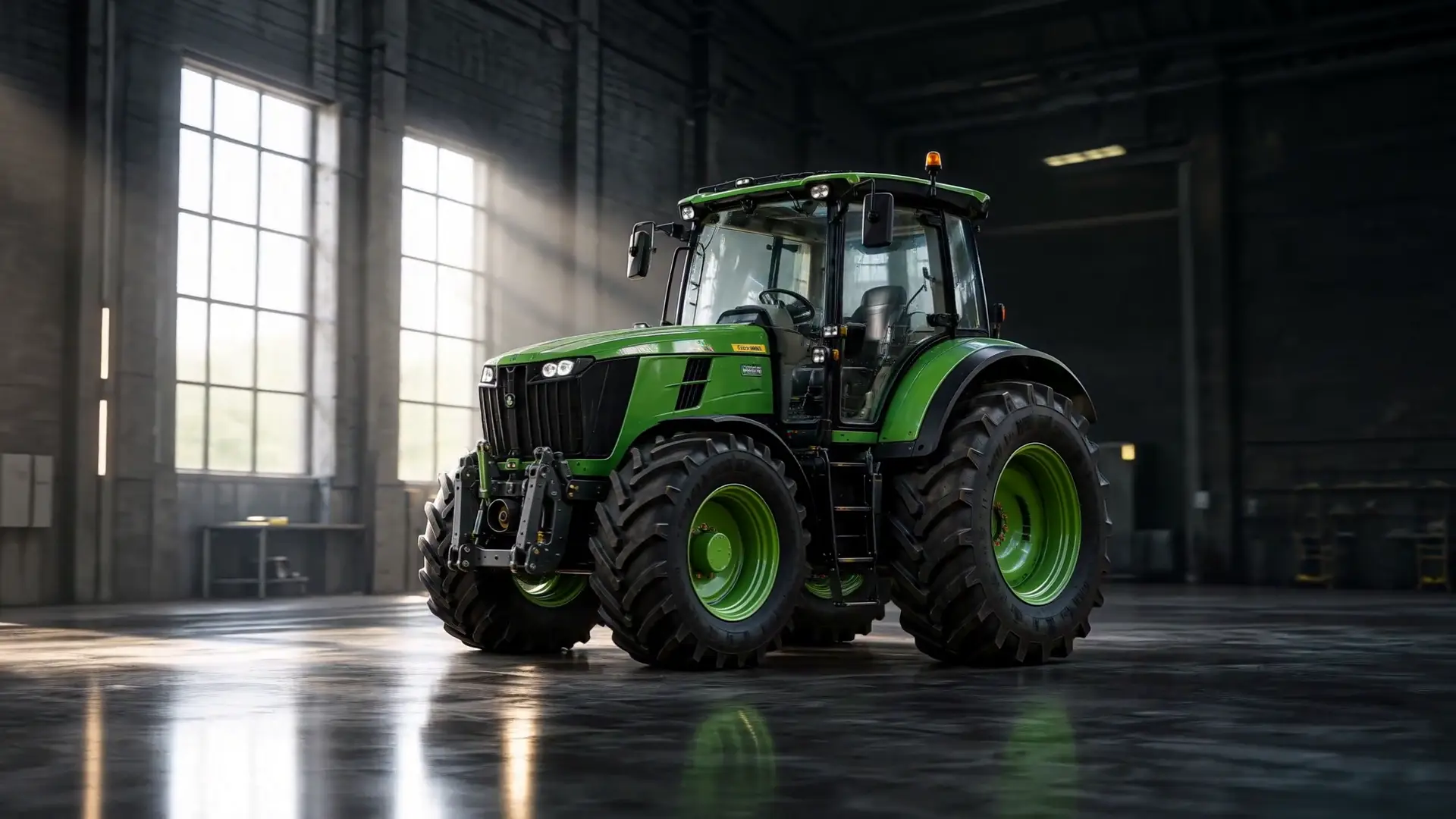
Tractor front loader
A front loader is a pair of hydraulic lifting arms fitted to the front of a tractor, carrying a bucket, forks or other tool. It turns an ordinary tractor into a machine that can load, lift, stack and carry around the farm.
Tractor power needed: About 20 to 200 hp, from compact tractors to large farm tractors
How it works
Brackets bolted to the tractor's sides carry the loader. Two arms joined by a cross beam pivot on these brackets, and hydraulic rams lift the arms while a second pair of rams tips the tool forward and back. Oil comes from the tractor's own hydraulic pump, controlled from the cab with a joystick or levers. Extra hydraulic services, often called third and fourth functions, can power grabs and other moving tools.
Many loaders have mechanical self-levelling. A parallel linkage, sometimes a Z-bar arrangement, keeps the tool at the same angle as the arms rise, so a pallet stays flat and a full bucket does not spill. Non-self-levelling loaders are simpler and cheaper and suit muck and soil work where tilt does not matter as much.
Main types and attachments
- Self-levelling loader: Keeps forks and buckets level through the lift. The common choice for handling pallets and bales.
- Non-self-levelling loader: Simpler arms with fewer pivots, giving good visibility and lower cost. The operator corrects tool angle by hand.
- Bucket: General purpose or high-tip for loading trailers, often with a toothbar for digging.
- Pallet forks and bale spears: For pallets, round bales and big square bales. Spears and grabs make bale and silage handling quick.
- Muck and silage grabs: Hydraulic jaws that clamp material in the bucket so it does not fall out.
- Quick-attach frame: A standard coupling that lets you change tools in seconds without tools. The Euro frame is common in Europe; compact tractors often use a skid-steer style coupling.
Hooking it up to a tractor
Front loaders suit tractors from compact utility models up to around 200 hp. Each loader needs tractor-specific mounting brackets, and modern designs park on stands so you drive in and out in a few minutes, with a multi-coupler connecting all the hoses at once. Rear ballast, either wheel weights or a weight block on the three-point linkage, is essential to keep the rear wheels planted when lifting.
A short history
Farmers built their own loaders long before factories did. A quick-attach front-end loader is credited to Abram Dietrich Thiessen of Saskatchewan in the 1940s, and in 1958 the Swedish firm Ålö introduced the drive-in Quicke loader, which set the pattern for fitting and removing a loader in minutes. Today almost every tractor maker offers a loader, and loader tractors remain a common sight on livestock farms.
Buying and care tips
- Keep the load low: Travel and turn with the bucket close to the ground. A raised load moves the centre of gravity up and makes the tractor far easier to tip over.
- Ballast correctly: Follow the maker's ballast advice and set the wheel track as wide as practical.
- Never work under a raised loader: Block or lower the arms before servicing, and keep people out of the work area.
- Watch overhead lines: Check for power cables before lifting high.
- Check pivots on used loaders: Worn pins and bushes give sloppy, unsafe control. Grease them regularly.
Questions people ask
What is a self-levelling front loader?
A loader with a linkage that keeps the tool at the same angle as the arms rise. Pallets stay flat and buckets do not spill.
What is a Euro hitch on a loader?
A widely used European quick-attach frame. Tools with a matching frame can be swapped in seconds.
Do I need rear ballast with a front loader?
Yes. Without rear weight the back wheels can lift under load, making steering and braking poor and raising the risk of overturning.
Can I take the loader off my tractor?
Most modern loaders park on built-in stands and can be removed in a few minutes. Removing it when not needed improves visibility and reduces wear.
Related equipment
Sources
- Loader (equipment), Wikipedia
- Fendt Cargo front loader, Fendt
- New N-series loaders from Quicke, Irish Farmers Journal
- Front-end loader safety, Ohio State University Extension (AEX-892.80)
Last checked 2026-11-01